Kosher Wines
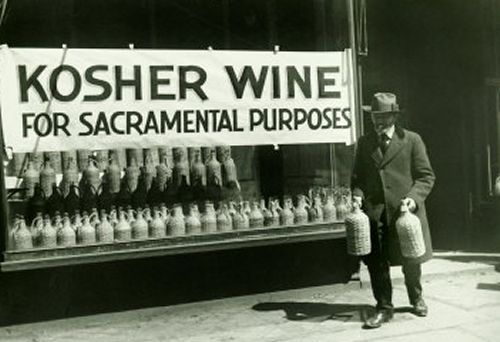
Kosher is an ancient Hebrew word that is translated as "fit" or "proper," and when applied to food or drink, it signifies that a particular substance is suitable for consumption according to Jewish ritual law. In recent times, there has been an increased demand for kosher wines and a number of wine producing countries now produce a wide variety of sophisticated kosher wines under strict rabbinical supervision, particularly in Israel, the United States, France, Italy, South Africa, Canada and Australia. Two of the world's largest producers and importers of kosher wines, Kedem and Manischewitz, are both based in the United States.
There are two ways of koshering wine. You can either cook it, or have it made by observant jews. Cooked kosher wines are more popular, as they can be opened and served by non-jews. With uncooked kosher wines, if they are to be used for religious purpose, they must be only opened and served by observant jews. Therefore they are usually only consumed in private homes and temples. Cooked wines are served at all kosher banquets and restaurants.
Rodrigues - Newfoundland
Munro Meadery - OntarioIn British Columbia Summerhill Pyramid Winery produced a uncooked Kosher wine
What Makes a Wine Kosher?
by Yael ZislingThere is a misconception about Kosher wine, that it simply doesn't 'hold-up', taste wise. However, one only has to taste some of Golan Heights Winery's wines (just as an example), to know that is simply not true. Kosher wine used to mean a sweet dark-red liquid - since the mid 1980's all that has changed.
With the emergence in recent years of so many boutique wineries in Israel, not all of the wine being produced locally is kosher. Many of the boutique wineries simply are unwilling or unable, (due to their growing and production methods) to produce kosher wines. For a wine to be kosher, strict regulations must be followed. It really all begins in the fields. Grapes from new vines may not be used for making wine, until after the fourth year. Every seventh year the fields must be left fallow and there is a prohibition on growing other fruits and vegetables between the vines.
All the equipment, tools and winemaking storage facilities must be kosher. During the harvest, only Sabbath observant male Jews are allowed to work on the production of the wines. Since most of the experienced winemakers in Israel are not observant, this means that they can't touch the wine or the equipment, during the winemaking process.
During the production of kosher wine, no animal products may be used. Gelatin or egg whites are sometimes used by non-kosher wine makers, to clarify the wine, while kosher wine makers use a clay material, called bentonite, which pulls suspended particles to the bottom of the barrel.
For wine to be kosher one percent of the wine must be discarded, a symbolic remnant of the 10% tithe, paid to the Temple in Jerusalem in days gone by. Additionally, barrels must be cleaned three times.
There are really two levels of kosher wine. The first includes the restrictions outlined above, while the second, known as "mevushal" utilizes an additional process. This is important since Kashrut law stipulates that in order for a wine to retain its 'kosherness' once opened and poured by a non-Jew, (such as a waiter, for instance) the wine must be "mevushal."
Bringing the liquid to a boiling point makes this type of wine, causing air bubbles to be brought to the surface and the loss of some wine, due to evaporation. A wine that is produced in this manner retains its religious purity, regardless of who opens or pours it. A study at the University of California at Davis, has proven that it is not possible to consistently taste the difference between non- mevushal and mevushal wine. To ensure wine's purity, the codification of koshering wine began in the days of Maimonides. Today, a quick glance at the bottle's label will clearly indicate whether the wine is kosher or not. Some truly wonderful kosher wine is being produced in Israel.
Kosher wine requires that it production be done by only Sabbath observant Jewish individuals. From the time the grapes are crushed until after the fluid is made into wine, it must be boiled. This is done in order to make sure that at now time it was sanctified for a foreign deity, or religious libation of any kind.
Rabbi Mitchell R. Cohen
Executive Director
Canadian Kosher Supervision Inc.
www.canadiankosher.orgFor a wine to be correctly labeled kosher, it must be produced in accordance with the Jewish dietary laws, also known as kashrut.
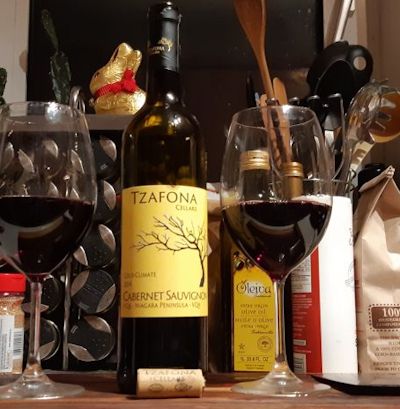
Tzafona Cellars Cabernet Suavigon -Kosher
Rodrigues Winery in Newfoundland
In 1998, The Kashruth Council of Toronto certified Rodrigues Winery Kosher and Pareve COR530 - the only Winery in Canada to receive this designation to date. Also, in 2000, in preparation for exporting the Wines to the USA, the Winery applied for and received OU certification from the Orthodox Union of Jewish Congregations of America. In 2001 an elevated certification as Kosher for Passover or OUP was received.
Why Kosher? In recent years, kosher has become one of the fastest-growing trends in the food and beverage industry, and publications as diverse as Adweek, Food and Wine Magazine and Rolling Stone have declared kosher to be one of the hot food and beverage trends coming out of the nineties. And why the rising popularity? To begin with, only 25% of the consumers who purchase kosher food and beverages are of the Jewish faith. In addition to those who do purchase kosher products for religious reasons, the majority of consumers are doing so because they are health conscious. Kosher certification carries that perception of "Good Housekeeping seal of approval" because of the strict laws governing production facilities and the stringent requirements attached to all components used in the processing of a consumable product.
At Rodrigues Winery, where our wild berries are grown in a pollution-free environment and our fruit is grown pesticide-free, we ensure that all of the ingredients as well as the processing equipment and environment for the making of our Wine meet or exceed the certification requirements for kosher. In fact, the winery is subjected to regular inspections by both Canadian and US approval agencies.Domaine Pinnacle a family-owned and operated orchard and cidery located on a 430-acre property on the slopes of Pinnacle Mountain near the historic village of Frelighsburg in the Eastern Townships of Quebec, Canada; produces a Kosher Ice Cider. Domaine Pinnacle Ice Cider and Domaine Pinnacle Sparkling Ice Cider
Domaine des Cotes d'Ardoise produces two Sacramental wines Estafette Blanc and Estafette Rouge
Tugwell Creek Honey Farm and Meadery located in Sooke British columbia produces Kosher Meads
Tugwell Creek Farm mead AND HONEY is 'BCK', certified Kosher
Summer Hill Pyramid Winery produces a uncooked Kosher wine Tiferet with Rabbi Shmuly Hecht To make uncooked kosher wine that may be used within a Jewish ceremony, it must be made by those who live their lives as Sabbath-observant Jews. They used the best organic grapes in a vintage year, Merlot, Cabernet Sauvignon, and Cabernet Franc, and aged the wine in 100% new French and American oak barrels.
The Kosher wine was made with hands off coaching by Eric von Krosigk Summer Hill Pyramid's winemaker.
Summerhill Pyramid Winery releases thier Kosher wine march 2014
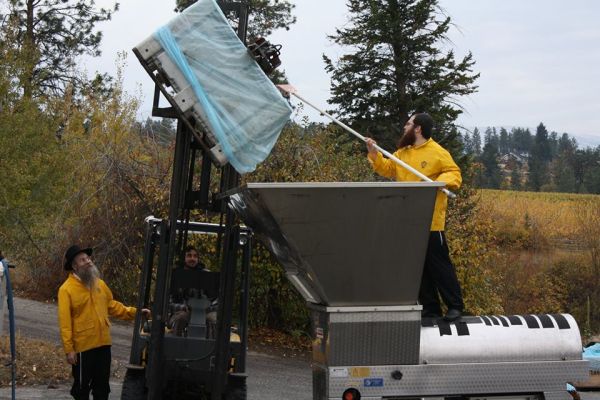
Once the skins are broken, the fruit and equipment can only be touched by the rabbis.
with Ari Cipes and Shmuly Hecht .
Huff Estates is proud to announce that in partnership with Rabbi Teitlebaum we have released the first kosher wine of Prince Edward County, and one of the only VQA kosher wines available in Ontario.
Please note wineries we list as producers may not make a kosher wine every year. It is difficult to track production of 800 plus wineries across our large country
Organic Wines ~ Fruit Wines ~ Fortified Wines ~ Icewine ~ Stephen Cipes
Home | Sitemap | New |Gallery | Contact Us | ©2017 Robert A Bell